Common Solar Sales Scams and Red Flags to Avoid
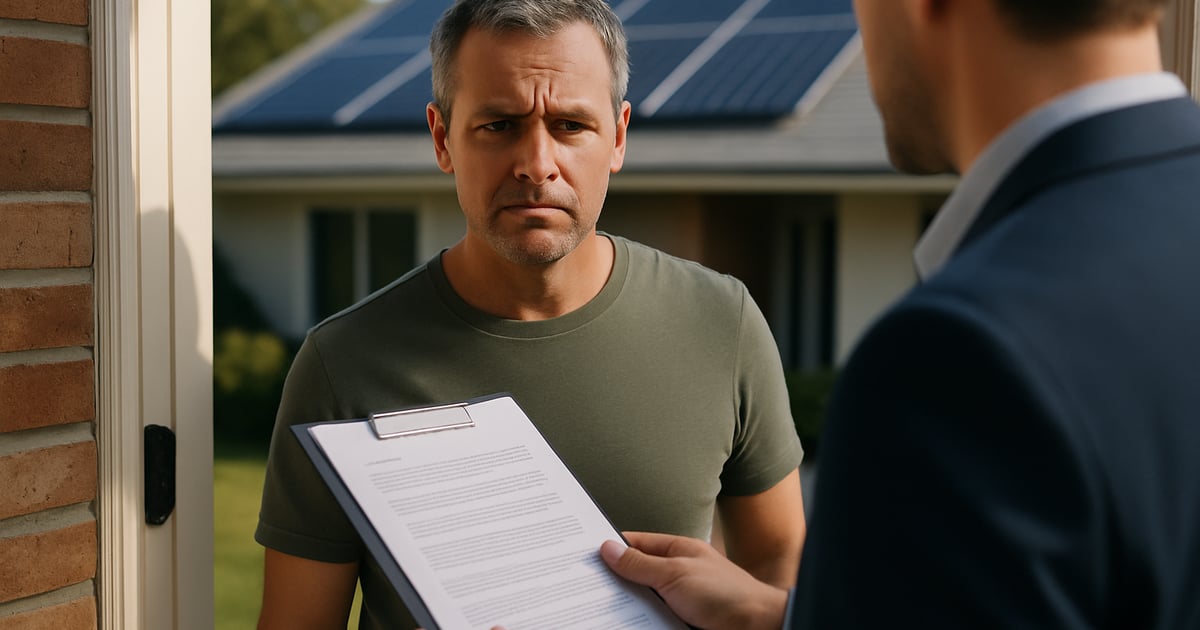
Solar is a real, financially sound option for many homeowners — which is exactly why it also attracts aggressive and sometimes dishonest sales tactics. Knowing the common patterns helps you shop with confidence.
”Free solar” claims
Solar panels are never literally free — a “free solar” pitch usually describes a lease or PPA with no upfront cost, where you pay for the electricity or a fixed lease payment over time instead. This isn’t necessarily dishonest if explained accurately, but it becomes a red flag when the actual financing structure isn’t clearly disclosed. See our financing comparison to understand what you’re really agreeing to.
False urgency and same-day pressure
Legitimate installers understand that a purchase costing thousands of dollars deserves time to compare quotes and think it over. Pressure to sign the same day — often paired with a claim that a discount or incentive expires immediately — is one of the most common and telling red flags in solar sales.
Fake or exaggerated “government program” claims
Some sales pitches imply the salesperson represents a government program, or that a specific incentive is only available for a limited, urgent window tied to government action. Legitimate incentive programs are publicly documented on official state or utility websites — verify any specific program name directly rather than trusting a verbal description. See our state incentives overview for how to check what’s actually available.
Inflated savings projections
Be skeptical of savings projections that seem dramatically higher than what our calculator or a reasonable ROI calculation would suggest for your situation. Ask exactly how the projection was calculated — what electricity rate, what rate of future utility price increases, and what system production assumptions were used.
Vague or shifting pricing
- Reluctance to provide a written, itemized quote with price per watt
- Pricing that changes significantly between conversations without a clear explanation
- Bundling financing costs into the “system price” in a way that makes it hard to compare against a cash price
Reluctance to answer direct questions
A legitimate installer should be able to clearly answer questions about licensing, insurance, specific equipment, warranty terms, and their company’s track record. Vague, evasive, or deflecting answers to direct questions are worth taking seriously as a warning sign.
How to protect yourself
- Never sign the same day you first hear a pitch — take the proposal home and compare it against other quotes.
- Get everything in writing, including specific equipment, pricing, and warranty terms.
- Verify licensing independently through your state’s contractor licensing board, not just the salesperson’s claim.
- Research the specific incentive programs mentioned on official government or utility websites.
- Check independent reviews, not just testimonials the company itself provides.
- Know your cancellation rights — many contracts include a legally required cancellation window; confirm the specific terms in your contract and your state’s consumer protection rules.
See our related guides on how to choose a solar installer and questions to ask before signing a contract for a fuller due-diligence process.
Bottom line
Most solar companies and salespeople are legitimate, and solar itself is a real, well-established technology — but the same properties that make it a good investment (real savings, real incentives) also make it a target for exaggerated or high-pressure sales tactics. Slowing down, getting things in writing, and verifying claims independently protects you regardless of which specific company you end up choosing.
Frequently Asked Questions
- Is door-to-door solar sales always a scam?
- Not necessarily — many legitimate installers do use door-to-door or community canvassing as a sales channel. The sales channel itself isn't the red flag; high-pressure tactics, vague answers, and reluctance to provide written documentation are the actual warning signs, regardless of how you were first contacted.
- What should I do if I already signed a contract I regret?
- Many solar contracts, like many major purchases, are subject to a legally required "cooling off" cancellation period (commonly a few business days) that lets you cancel without penalty shortly after signing — check your specific contract and consult your state's consumer protection office for the rules that apply to you.
- How do I verify if a company is really government-affiliated like they claim?
- Legitimate government incentive programs are publicly listed on official state energy office or utility websites — search for the specific program name directly rather than trusting a salesperson's description of it, and be skeptical of any company implying they are themselves a government program or agency.