Solar Panel Costs and Savings in California (2026 Guide)
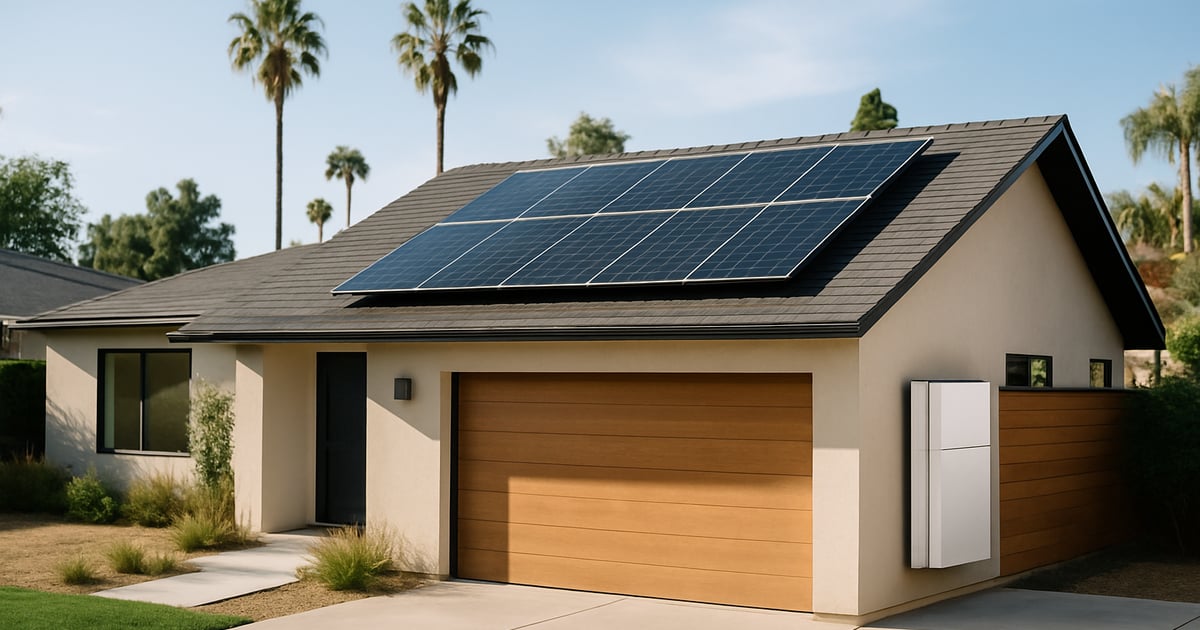
California has the highest residential electricity rates of any state in our guides — and the least generous export compensation. Those two facts together define solar economics here in 2026: self-consumption is extremely valuable, exporting is not.
California solar at a glance (July 2026)
| Metric | Figure |
|---|---|
| Avg. residential electricity rate | 35.25¢/kWh (EIA, April 2026) — highest of our 15 states; U.S. average is 18.83¢ |
| Avg. peak sun hours | ~5.8 per day (NREL-based estimate) |
| Typical installed cost | ~$2.40–$3.35 per watt before incentives (2026 national range) |
| Export compensation | NEM 3.0 “Net Billing”: roughly 3–8¢/kWh, varies hourly |
| Federal tax credit | None for purchases after Dec 31, 2025 (details) |
| Headline state incentive | SGIP battery rebates; property tax exclusion |
The NEM 3.0 reality: exports earn ~5¢, grid power costs ~35¢
Since April 2023, new solar customers of PG&E, Southern California Edison, and SDG&E fall under NEM 3.0 (officially the Net Billing Tariff). Exported electricity is credited at hourly “avoided cost” values — typically in the 3–8¢/kWh range — instead of the near-retail credit earlier customers received. Meanwhile the average residential rate you pay for grid electricity is 35.25¢/kWh (EIA, April 2026).
That roughly 7-to-1 gap between what you pay and what you earn for exports is the single most important number in California solar. It means a system designed to export heavily makes little sense, while a system paired with a battery — storing midday production for evening use — captures close to the full retail value of every kWh.
SGIP: the main remaining rebate
With the federal residential credit gone as of January 2026 and no state income tax credit, California’s principal cash incentive is the Self-Generation Incentive Program (SGIP) for battery storage. General-market rebates run roughly $150–$1,000 per kWh of storage capacity depending on the funding category, and the Equity Resiliency track — for qualifying low-income households and homes in high fire-threat districts or affected by power shutoffs — pays substantially more per kWh. Funding moves in steps and can pause, so confirm the current budget for your utility territory before building it into your quote.
California also excludes solar installations from property tax reassessment, so adding a system doesn’t raise your property taxes.
Wildfire shutoffs make backup power a real factor
PG&E and other utilities conduct Public Safety Power Shutoffs during extreme fire-risk conditions. For homeowners in affected areas, a solar-plus-battery system is partly a resilience purchase, not just a financial one — and it’s exactly these areas that often qualify for SGIP’s highest rebate tiers.
Sizing in a NEM 3.0 world
With ~5.8 peak sun hours, California systems produce a lot per installed watt. But under NEM 3.0, oversizing is penalized: excess exports earn little. Size to your actual consumption pattern — ideally shifting usage (EV charging, pool pumps, laundry) into solar hours — and run your numbers with our calculator, which uses California’s current EIA rate.
Bottom line
California solar in 2026 is a self-consumption game: 35¢ grid power makes every kWh you use from your own roof extremely valuable, while NEM 3.0 makes exports nearly worthless. For most homeowners the realistic comparison is solar-plus-battery (helped by SGIP) versus doing nothing — and with the state’s rates still climbing, that case remains strong even without the federal credit.
Sources
Frequently Asked Questions
- Is solar still worth it in California after NEM 3.0?
- Often yes, but the math now favors solar-plus-battery. Under NEM 3.0, excess electricity exported to the grid earns roughly 3–8 cents per kWh, while grid electricity costs about 35 cents per kWh on average (EIA, April 2026). Storing your excess production and using it in the evening is worth several times more than exporting it, which is why most new California installations now include a battery.
- Does California have a state solar tax credit?
- No. California has no state income tax credit for solar, and the 30% federal residential credit ended December 31, 2025. The main remaining incentives are SGIP battery rebates, a property tax exclusion for the added home value, and the high electricity rates that make self-consumed solar valuable.
- What is SGIP and how much is it worth?
- The Self-Generation Incentive Program is California's battery storage rebate, administered through the major utilities. General-market rebates run roughly $150–$1,000 per kWh of battery capacity, and the Equity Resiliency track for qualifying low-income households or homes in high fire-threat areas pays substantially more. Funding levels and eligibility vary, so confirm current availability for your utility before counting on a specific amount.