Solar Panel Costs and Savings in Massachusetts (2026 Guide)
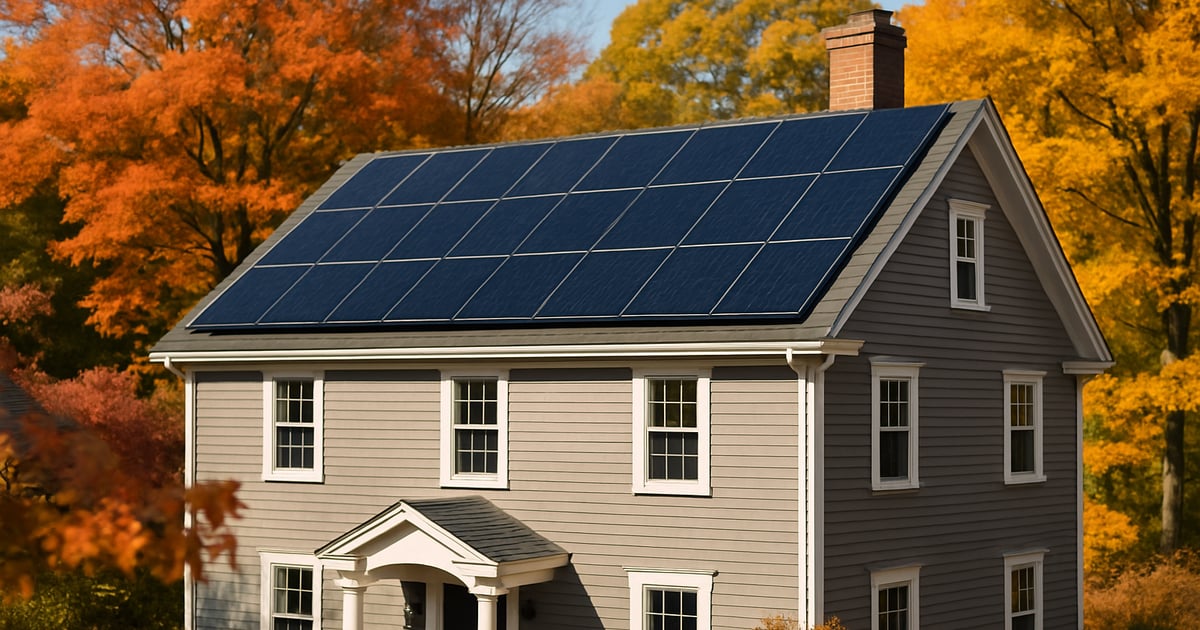
Massachusetts sells solar on price, not sunshine: at nearly 30¢/kWh for grid power, plus a production subsidy on every kWh generated, weak sun hours stop mattering.
Massachusetts solar at a glance (July 2026)
| Metric | Figure |
|---|---|
| Avg. residential electricity rate | 29.45¢/kWh (EIA, April 2026) — tied with New York, behind only California in our guides |
| Avg. peak sun hours | ~4.0 per day (NREL-based estimate) |
| Typical installed cost | Highest in our guides — reported around $3.60/W in 2026 (national range $2.40–$3.35/W) |
| Export compensation | Full retail net metering |
| Federal tax credit | None for purchases after Dec 31, 2025 (details) |
| State incentives | SMART 3.0 ~3¢/kWh × 10 years + 15% tax credit up to $1,000 + tax exemptions |
SMART 3.0: paid per kWh, on top of net metering
The Solar Massachusetts Renewable Target (SMART) program pays you for every kWh your system generates — not just what you export — for 10 years. Under SMART 3.0, the residential base rate is about $0.03/kWh, with two notable adders:
- +$0.04/kWh for pairing the system with battery storage
- $0.06/kWh base rate for income-qualified households
Crucially, SMART runs alongside net metering, not instead of it. A 7 kW system producing ~8,000 kWh a year earns roughly $240/year in base SMART payments for a decade while also offsetting 29.45¢ grid power. Rates are administered by the Department of Energy Resources and have stepped down through program generations — confirm the current rate when you apply.
The rest of the stack
- State tax credit: 15% of system cost, capped at $1,000, against Massachusetts income tax.
- Sales tax exemption: solar equipment is exempt from the state’s 6.25% sales tax.
- Property tax exemption: the system’s added value is exempt for 20 years.
- Full retail net metering: exports credit one-to-one at retail rates — see our net metering guide.
No single piece is huge, but stacked on 29.45¢ electricity the combined per-kWh value of Massachusetts solar production trails only New Jersey and New York in our guides.
The catch: the highest installed costs in the country
Massachusetts consistently reports the highest per-watt installed prices among our 15 states — around $3.60/W in 2026 versus a ~$2.58/W national average — driven by labor costs, older housing stock, and permitting overhead. That premium eats part of the incentive stack, and it makes comparison shopping unusually valuable here: the spread between a $3.20/W and a $3.80/W quote on an 8 kW system is nearly $5,000. Use our installer checklist, and get every quote in per-watt terms.
Winter is priced in
~4.0 sun hours with real snow means winter production drops meaningfully — but annual production estimates already average this in, and cold, clear days are actually efficient ones for panels. See the winter guide, then run annual numbers with the calculator.
Bottom line
Massachusetts combines near-30¢ electricity, a 10-year production subsidy, a modest tax credit, and full retail net metering into one of the strongest ongoing-value propositions in our guides — held back mainly by the country’s highest installation prices. The homeowners who do best here are the ones who shop hardest on per-watt price.
Sources
Frequently Asked Questions
- What does the SMART program pay in 2026?
- Under SMART 3.0, residential systems earn a base incentive of about $0.03 per kWh generated, paid for 10 years — on top of (not instead of) net metering credits. Adding battery storage raises the rate by about $0.04 per kWh, and income-qualified households get a $0.06 base rate. On a 7 kW system producing ~8,000 kWh a year, the base payment alone is roughly $240 annually for a decade.
- How much is the Massachusetts state solar tax credit?
- 15% of system cost, capped at $1,000, claimed against Massachusetts income tax. Modest next to New York's $5,000 credit, but it stacks with SMART payments, full retail net metering, a sales tax exemption, and a 20-year property tax exemption. The federal residential credit ended December 31, 2025 and no longer applies.
- Is solar worth it in Massachusetts with only ~4 sun hours a day?
- Generally yes — Massachusetts has the highest electricity rates in our guides after California, at about 29.5¢/kWh (April 2026). Payback here is rate-driven: each kWh produced offsets nearly 30 cents of grid power and earns a SMART payment on top, which more than compensates for the modest sun resource.